
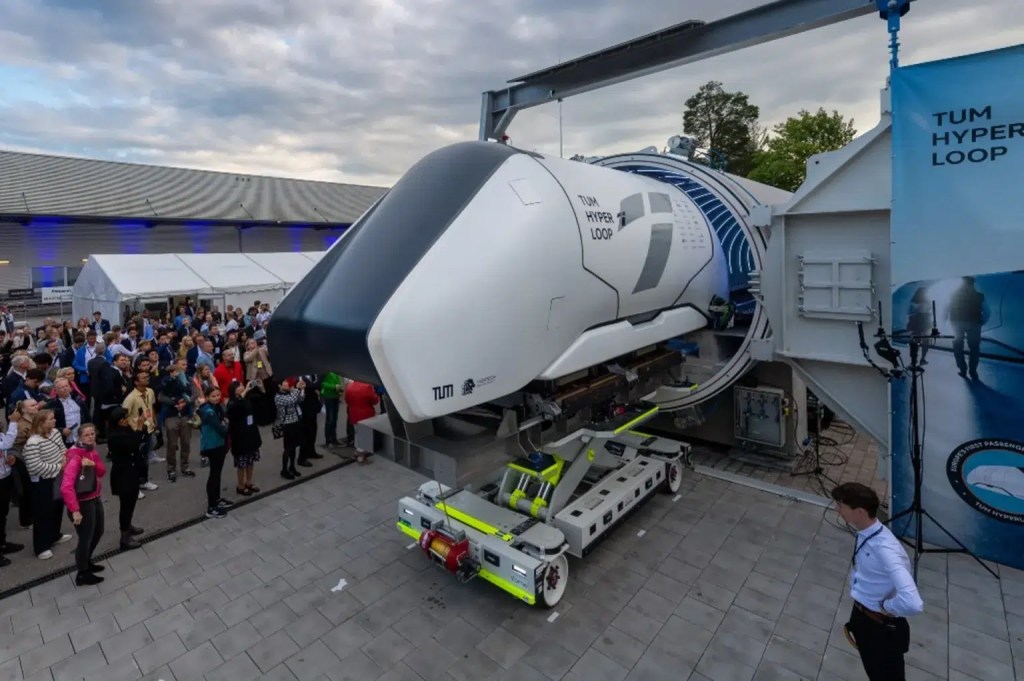
The Ultimate Lesson in Why Theoretical Physics Cannot Outrun Brutal Unit Economics.
In 2013, Elon Musk published a 58-page whitepaper proposing a 700-mph vacuum-tube transit system that would connect Los Angeles and San Francisco in 35 minutes. It was supposed to be the fifth mode of transportation, immune to weather, frictionless, and completely powered by solar.
In 2026, the verdict is in: the passenger Hyperloop is mathematically and commercially dead.
The Western dream of vacuum-tube transport collapsed under the weight of its own infrastructure costs. Hyperloop One—the most heavily funded startup in the space—burned through $450 million before officially liquidating its assets and shutting down on December 31, 2023. In March 2026, Europe’s biggest hope, Dutch pioneer Hardt Hyperloop, filed for bankruptcy. The only entities still pushing the magnetic levitation limits are Chinese state-backed aerospace labs, and they are doing it to test military drones and rocket tech, not to commute passengers.
For operators like you at the Lyun Group, the Hyperloop saga is the ultimate reality filter. It is a stark warning of what happens when visionaries confuse a theoretical engineering concept with a scalable, executable business model. You can solve the physics of magnetic levitation, but if you cannot acquire the land rights, maintain a near-perfect vacuum over 500 miles, and do it cheaper than a simple airplane ticket, the market will mercilessly slaughter your project.
At a Glance
- Concept Origins: Elon Musk’s 2013 “Hyperloop Alpha” Whitepaper.
- Core Mechanism: Magnetic levitation (Maglev) inside a near-vacuum steel tube.
- Theoretical Top Speed: ~760 mph (1,220 km/h).
- Status of Western Pioneers: Hyperloop One (Shut down 2023), Hardt Hyperloop (Bankrupt 2026).
- Current Global Leader: China Aerospace Science and Industry Corporation (CASIC), operating strictly in experimental lab conditions.
- The Primary Bottleneck: Astronomical infrastructure costs, land acquisition, and thermal expansion physics.
Key Takeaways
- The Capital Bonfire: Hyperloop startups managed to raise hundreds of millions of dollars during the zero-interest-rate era based purely on CGI renders and short test tracks. When the capital dried up, the sheer cost of building vacuum-sealed steel tubes over thousands of miles broke the unit economics.
- The Chinese Military Pivot: While the West abandoned the passenger dream, China’s Donghu Laboratory recently pushed a 1.1-ton experimental maglev pod to 800 km/h in just 5.3 seconds (August 2026). However, this is generating 2.9 Gs of acceleration—lethal for a comfortable passenger ride. It is an aerospace and industrial testing platform, not a commuter train.
- The Boring Company’s Retreat: Elon Musk’s Boring Company originally promised to build hyperloops. Reality forced a massive pivot. Today, they are simply digging narrow tunnels for standard Tesla cars to drive through (like the Vegas Loop)—a far cry from 700-mph vacuum pods.
- The Triumph of High-Speed Rail (HSR): While Silicon Valley was trying to reinvent the wheel, countries like Japan, France, and China continued expanding traditional high-speed rail. HSR requires no vacuum tubes, is entirely proven, and operates at a highly efficient 200 mph.
- Operational Minimalism Failed: The Hyperloop violated the core rule of execution—simplicity. Maintaining a vacuum across hundreds of miles of steel tube exposed to massive temperature swings and earthquakes is an engineering nightmare that adds zero commercial value over a standard airplane.
Historical Timeline
| Date | Milestone | Key Details |
| August 2013 | The Whitepaper | Elon Musk releases the “Hyperloop Alpha” concept to the public as open-source, sparking a frenzy of VC-backed startups. |
| May 2016 | The First Physical Test | Hyperloop One conducts the first public test of its linear induction propulsion system in the Nevada desert. |
| November 2020 | First Passenger Test | Virgin Hyperloop puts two executives in a pod for a 500-meter test. It reached 107 mph (172 km/h)—a fraction of the promised 700 mph. |
| December 2023 | The Collapse | Hyperloop One officially shuts down, laying off staff and selling its remaining intellectual property to DP World. |
| March 2026 | European Bankruptcy | Hardt Hyperloop files for bankruptcy in the Netherlands, effectively ending the European dream of tube-based transit. |
| August 2026 | The Chinese Lab Test | China’s CASIC accelerates an experimental maglev pod to 800 km/h in 5.3 seconds, transitioning the tech strictly into an aerospace and industrial laboratory. |
The Core Engine: How It (Theoretically) Works
The Vacuum Tube
Air resistance is the enemy of speed. An airplane has to climb to 30,000 feet just to find thin enough air to cruise efficiently. The Hyperloop’s goal was to bring that 30,000-foot environment down to ground level. By pumping almost all the air out of a massive steel tube, aerodynamic drag is virtually eliminated.
Magnetic Levitation (Maglev) & Linear Motors
Because there is no air, you cannot use jet engines. Instead, the pod relies on electromagnetic propulsion.
- Levitation: The pod floats above the track using powerful magnets, eliminating physical friction against the rails.
- Propulsion: A linear induction motor (essentially a standard electric motor unrolled flat along the track) uses electromagnetic pulses to pull the pod forward.
The fundamental flaw was never the pod; it was the tube. A 300-mile steel pipe expands and contracts by dozens of feet depending on the heat of the sun. Engineering expansion joints that can flex while maintaining a near-perfect vacuum is astronomically expensive.
Key Numbers
| Metric | The Hyperloop Reality Check |
| Hyperloop One Capital Burned | ~$450 Million |
| Maximum Passenger Speed Reached | ~107 mph (172 km/h in 2020) |
| Cost Per Mile (Estimate) | $50M to $150M+ (Never proven at scale) |
| CASIC Lab Test Acceleration | 2.9 Gs (Lethal for standard commute) |
| Operating Commercial Hyperloops (2026) | Exactly Zero |
Common Misconceptions
“The technology just needs a few more years to mature.”
The core technology (Maglev and vacuum pumps) has existed for decades. The failure of Hyperloop is not a technological problem; it is a land-acquisition, regulatory, and infrastructure-cost problem. You cannot fix bad unit economics with “more time.”
“It would have been cheaper than high-speed rail.”
This was the biggest lie in the original 2013 whitepaper. Musk estimated a California track would cost $6 billion. Civil engineers immediately pointed out that acquiring the land rights alone would cost more than that, let alone building a climate-controlled, earthquake-proof vacuum tube.
Why It Matters for Businesses
The Reality Filter: Ideas vs. Execution
For the Lyun Group and Lumaw, the death of the Hyperloop is a masterclass in the dangers of over-engineering.
- Complexity Kills: The hyperloop attempted to solve a problem (fast transit) by introducing a thousand new points of catastrophic failure (vacuum depressurization, thermal expansion, pod bottlenecks). High-speed rail solves the same problem with minimal complexity. In your software and operational ecosystems, if a module introduces extreme backend complexity without an immediate, proven ROI, you must eliminate it.
- The Cost of Hubris: Capital is unforgiving. Hyperloop founders believed that because they could raise money, they could bend the laws of infrastructure physics. They were wrong. Never confuse VC funding with market validation. If the baseline unit economics of your execution are flawed, scaling the operation will only accelerate your bankruptcy.
Investment Perspective
The private equity and venture capital markets have completely abandoned passenger hyperloop projects. The sector has been written off as a zero-interest-rate hallucination.
The only surviving investments in this space are pivoting heavily toward military and aerospace applications. Investors are closely watching China’s magnetic levitation labs, not because they will build a train, but because a track that can accelerate a 1-ton object to 800 km/h in 5 seconds is essentially a land-based railgun. The technology is being repurposed for drone launching, missile testing, and moving heavy industrial loads.
FAQ
What happened to Virgin Hyperloop / Hyperloop One?
After reverting its name from Virgin Hyperloop back to Hyperloop One, the company failed to secure contracts to build a working system. By the end of 2023, it liquidated its assets, laid off its staff, and transferred its remaining IP to its major backer, DP World.
Is Elon Musk still building a Hyperloop?
No. Musk wrote the initial whitepaper but never started a dedicated hyperloop company. His tunneling venture, The Boring Company, completely abandoned the vacuum-tube concept and now focuses on digging standard tunnels for Teslas.
What is the fastest a Hyperloop ever actually went?
In an unmanned test on the Nevada track in 2017, the pod reached 240 mph (386 km/h). The only test with actual human passengers reached just 107 mph (172 km/h).
Why is it so dangerous?
If a high-speed train derails, it is a tragedy. If a hyperloop tube suffers a structural breach at 700 mph, the atmosphere rushes into the vacuum at the speed of sound, creating a shockwave that would instantly crush any pod inside the tube.
Why did Hardt Hyperloop go bankrupt?
In March 2026, despite having built a 420-meter test facility in Veendam (the longest in Europe), the Dutch company filed for bankruptcy. The exact financial trigger is classified, but it follows the industry-wide trend: developing ultra-fast tube infrastructure burns capital faster than any private entity can sustain without massive government bailouts.


