
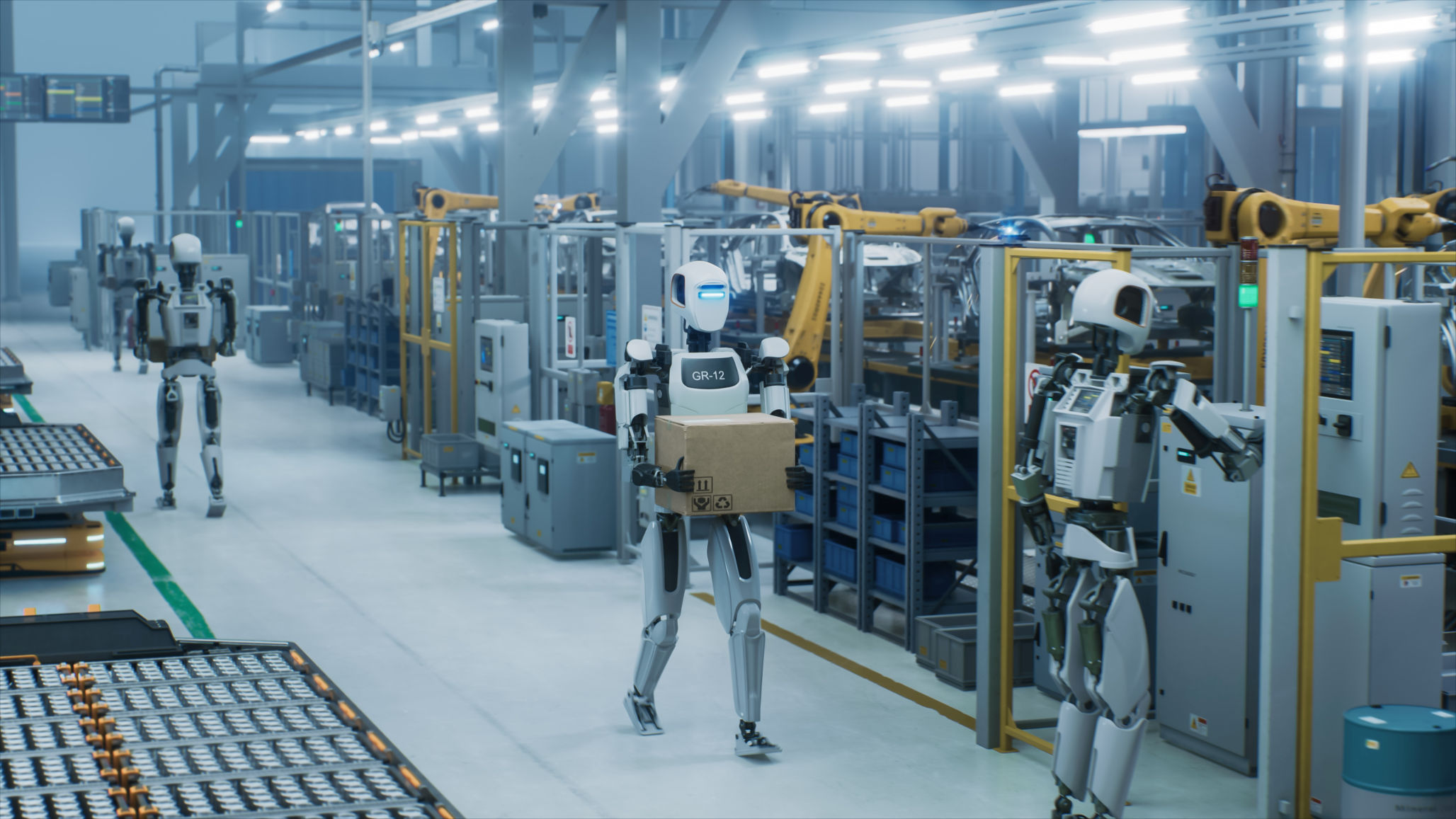
For most of modern manufacturing, a robot had a relatively simple relationship with the world around it: it was given a task, a sequence and a controlled environment, and its job was to repeat the same movement with extraordinary precision. That model transformed production, but it also imposed a clear boundary. The more predictable the environment, the more useful the machine became.
Artificial intelligence is beginning to change that boundary. Advances in computer vision, simulation, foundation models and real-time computing are allowing robots to interpret their surroundings, respond to changing conditions and perform tasks that are less completely predefined. NVIDIA, ABB, FANUC, Siemens and Rockwell Automation are approaching this transition from different directions, but together they reveal a broader movement: robotics is shifting from isolated industrial automation toward intelligent physical systems.
The Robot Is Learning to See
The most important change may not be mechanical at all.
A traditional industrial robot does not need to understand what it is looking at. It needs to know where an object should be and how to move toward it. Give the machine sufficiently precise instructions and a sufficiently controlled environment, and it can perform the same operation thousands of times.
AI introduces a different possibility. With cameras, sensors and increasingly capable models, a robot can begin to interpret what is happening rather than simply execute a predetermined sequence.
That distinction is becoming visible across the industry. FANUC, for example, is now positioning its manufacturing systems around Physical AI that allows robots to see, reason and act in real-world production environments. Its latest demonstrations combine robotics, automation, CNC systems and AI to make industrial processes more flexible and adaptable.
The underlying idea is simple, but its implications are not: the machine is becoming less dependent on the assumption that everything around it will remain exactly as expected.
That is the first step toward autonomy.
Intelligence Is Becoming a New Layer of Robotics
Once robots can perceive the physical world, another problem appears: they need somewhere to learn what to do with that information.
This is where NVIDIA has positioned itself unusually well.
Rather than competing primarily as a traditional industrial robot manufacturer, NVIDIA is building a technological layer around physical AI. Its Isaac platform, Cosmos world models and GR00T models are designed to help developers train, simulate and deploy intelligent machines, including humanoid robots. The company is effectively applying the logic of modern AI development to robotics: models are trained with data, tested in simulated environments and then deployed into the physical world.
That matters because teaching a robot every possible physical situation individually would be extraordinarily expensive and slow. Simulation and foundation models offer another route. A machine can experience enormous numbers of scenarios virtually, allowing developers to test behavior before placing a physical robot on a factory floor, warehouse or other environment.
NVIDIA’s 2026 robotics announcements illustrate how quickly this architecture is developing. Its ecosystem now spans simulation, world models, humanoid foundation models, edge computing and physical AI development, with companies including ABB and FANUC integrating parts of the technology into their own robotics workflows.
The robot, in other words, is no longer being developed as an isolated machine.
It is becoming part of an AI stack.
The Factory Is Becoming a System
That changes the role of companies such as ABB, Siemens and Rockwell Automation.
ABB has spent decades building industrial robots. Its newer robotics strategy increasingly combines AI vision, mobility, dexterity, human-robot interaction and simulation under what it calls Autonomous Versatile Robotics. Its approach suggests that the next generation of industrial machines will need to operate across more variable environments rather than remaining permanently assigned to a single repetitive task.
Siemens is approaching the same transformation from the broader industrial system. Its software and automation platforms connect engineering, production, digital twins and industrial AI, while its newer AI initiatives are designed to place intelligent agents directly into production environments. The objective is not simply to make an individual machine smarter, but to create manufacturing systems in which data, software, machines and people can work together more dynamically.
Rockwell Automation illustrates another part of the transition. Through its industrial automation platforms and OTTO autonomous mobile robots, the company is connecting physical movement with software, production data and AI-driven decision-making. Its recent demonstrations show autonomous mobile robots, digital twins, cloud infrastructure and industrial automation operating as parts of the same system rather than as separate technologies.
The distinction is important.
The future factory is not simply going to contain more robots.
It is likely to contain more intelligence connecting the robots together.
And Then the Robot Leaves the Factory
This is where humanoids become particularly interesting.
The fascination with humanoid robots is often presented as a race to reproduce the human body: two legs, two arms, hands, cameras and a head. But the deeper reason humanoids matter is that the physical world was already designed around the human form.
Buildings have doors. Warehouses have shelves. Factories have workstations. Tools have handles. Production environments are filled with objects and interfaces designed for human movement.
A sufficiently capable humanoid therefore does not necessarily require an entirely new environment.
It can potentially enter the one that already exists.
NVIDIA’s robotics work reflects this direction, with its GR00T platform specifically targeting general-purpose humanoid robots and combining vision-language-action models with simulation and real-time computing. The company has also introduced an open humanoid reference design intended to accelerate development and research.
But humanoids are only one expression of the trend.
Autonomous mobile robots are already moving through factories and warehouses. Computer vision is being used for inspection and quality control. Robotic arms are becoming more adaptable. Digital twins are allowing entire production environments to be simulated before deployment.
The physical world is gradually becoming programmable.
The Race Is Bigger Than Humanoids
That is why focusing exclusively on humanoid robots can be misleading.
The real robotics race is about whether machines can move from following instructions to interpreting situations.
A mobile robot that can dynamically navigate a warehouse is part of this transition. So is an industrial arm that can recognize objects in different positions. So is a factory system that can simulate a production change before implementing it. So is a humanoid that can understand a natural-language instruction and translate it into a sequence of physical actions.
Rockwell’s autonomous mobile robotics business provides a useful example. Its OTTO systems use AI-driven navigation and real-time coordination to move materials through changing industrial environments, while its software connects those machines to broader production workflows. The robot is no longer simply a piece of equipment transporting something from A to B; it becomes part of an adaptive logistics system.
This is the larger transformation.
Autonomy is becoming a system capability rather than a feature of an individual robot.
The Economics Change With It
For decades, industrial robotics made economic sense primarily when a company had a repetitive task worth automating at sufficient scale.
That created a natural limitation. Highly variable work remained difficult to automate because programming a machine for every possible exception could cost more than employing a person.
AI attacks that limitation from another direction.
If robots become capable of interpreting variation instead of requiring every variation to be explicitly programmed, the number of economically viable applications could expand.
That does not mean humans disappear from industrial environments. In many cases, the more immediate opportunity is different: machines take over physical tasks that are repetitive, dangerous or difficult to staff, while people remain responsible for supervision, judgment and more complex work.
The economic prize is therefore not simply more automation.
It is the ability to automate environments that were previously considered too unpredictable.
The New Robotics Architecture
The pieces are beginning to fit together.
NVIDIA is building computing, simulation and foundation models for physical AI. ABB is bringing perception, mobility and adaptability into industrial robotics. FANUC is combining established manufacturing automation with AI-driven robotics. Siemens is connecting industrial software, engineering and AI. Rockwell is integrating automation, autonomous movement and production intelligence.
They are not building the same product.
That is precisely why the group is interesting.
Together, they illustrate the emergence of a new architecture in which AI provides intelligence, sensors provide perception, robotics provides physical action, simulation provides a training environment, and industrial software connects everything to the operation around it.
The robot itself is only one component.
The larger system is the real innovation.
And that may ultimately determine how far robotics can move beyond the factory.
The first industrial revolution taught machines to perform physical work with extraordinary consistency. The next one is beginning to teach them how to operate in a world that is not perfectly predictable.
That is why the new robotics race is not really about building machines that move better.
It is about building machines that understand enough of the physical world to decide what to do next.
Once that capability becomes reliable, the boundary between automation and autonomy starts to disappear.


